Automotive go-to-market strategy: Key tips for suppliers entering the automotive industry

Six Lines - Automotive Go-to-Market Support
A capable company decides to enter automotive. The product performs well in other sectors. The sales narrative is refined. Early meetings with automotive teams are positive. Interest is genuine… and then momentum slows.
For companies new to the sector, this is disorientating, as the product solves a real problem and is a proven success in other industries, but the sale simply did not happen. To understand why, it helps to understand what the automotive industry has lived through over the past decade.
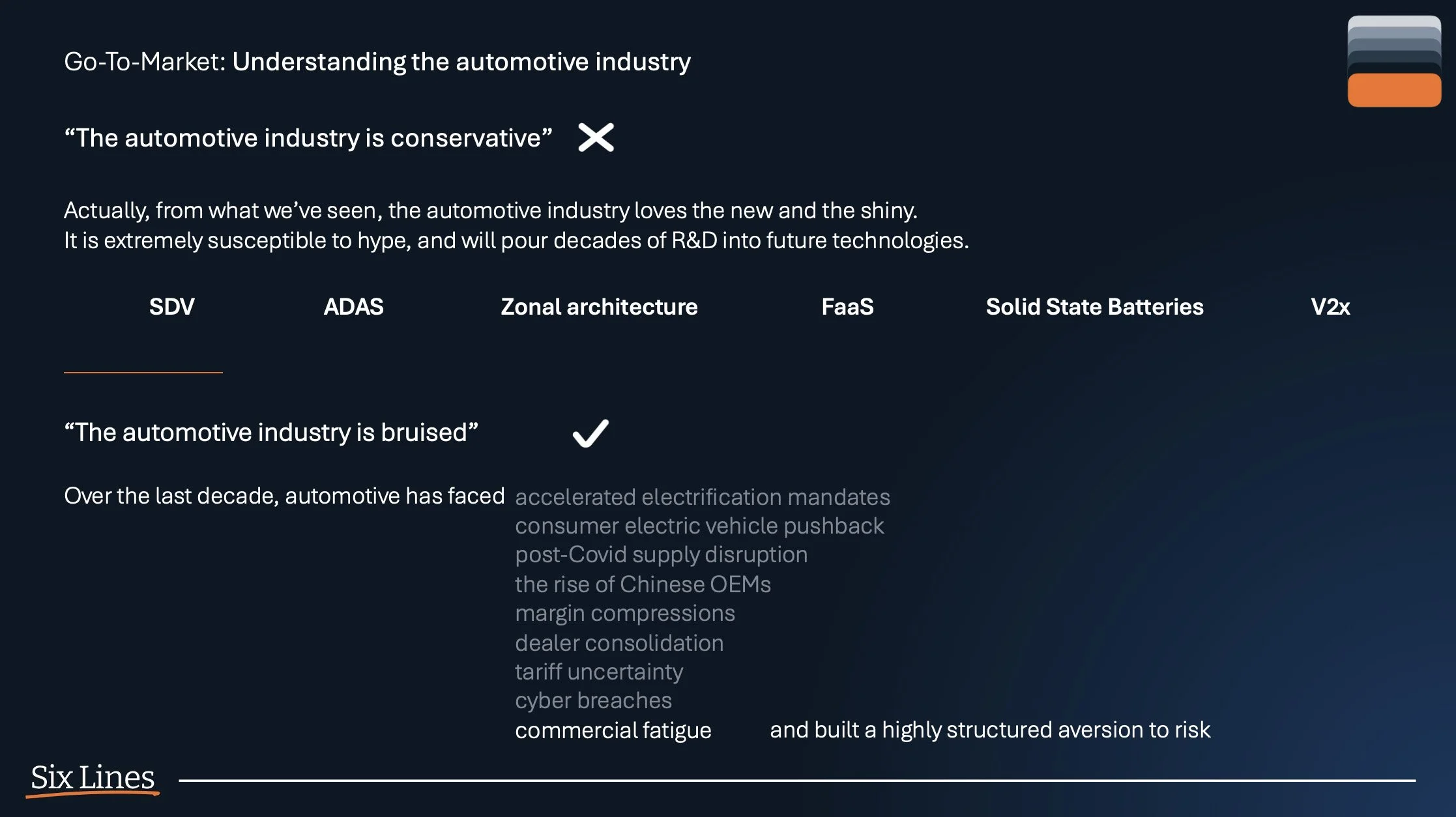
Regulatory shifts reshaped product roadmaps. Tariffs and trade instability have complicated supply chains. A global pandemic exposed structural fragility. The push toward electrification accelerated faster than many balance sheets were comfortable with, while consumer demand hasn’t followed. At the same time, new competitors, particularly from China, have changed the competitive landscape and pricing expectations. The result is an industry that has absorbed sustained volatility. Cost pressure is constant, programme risk is scrutinised closely, margins are thinner, and boards are more cautious. Basically, automotive OEMs are carrying some bruises right now.
Against that, your product is seen mainly seen as another source of risk, and you need to mitigate that feeling.
Automotive caution is structural
Caution in the automotive industry is structural. Vehicle programmes span years, sometimes decades, with multiple product programs running alongside each other at vastly different stages. Purchase decisions affect compliance exposure, warranty liability, supplier relationships and brand risk, so a new product isn’t just judged on its functionality, it is judged on how safely it fits into an existing ecosystem that cannot afford instability.
Six Lines Marketing
Companies entering the automotive industry often structure their product strategy and marketing messaging as though they are selling into a single department. Usually the one that would use the product day-to-day. They will shape the narrative the end user or the workflow owner. The functional benefits will be made clear and the use case will be well explained. But automotive decision-making rarely sits neatly inside one department.
The team that would use the product may not control the budget. The team that sees the efficiency gain probably doesn't carry the integration risk. The person who understands the workflow improvement may not be the one who must defend the decision at a performance review.
Teams often build their product strategy and messaging around a single user groups, underestimating just how many people must feel comfortable before approval is granted.
The translation gap

We often see early positioning leaning heavily into how the product works. There are detailed explanations of architecture, automation logic, workflow design and integration layers. Lots of how, what, where and when, and very little discussion of why it matters in programme terms.
Decisions rarely sit with one person who sees the whole picture. Engineering may understand the technical elegance. Operations may recognise the workflow improvement. Finance may look for cost impact. Compliance may focus on exposure and audit traceability. Procurement will examine supplier risk. Each will see part of the diagram, but they don’t all see the same part. If your messaging relies on the buyer connecting those dots themselves, you are assuming someone will assemble the full picture internally. In practice, different stakeholders see different fragments. If the links are not explicit, the picture won’t form correctly.
In other industries, a technically strong proposition may survive on enthusiasm alone. In automotive, if relevance to measurable outcomes is not clear, momentum fades as the proposal moves from one internal conversation to the next.
The reality of selling to an automotive OEM
Selling into an automotive OEM is rarely a linear enterprise transaction.
Take software as an example. An innovation team may see potential. Engineering will assess feasibility. Cybersecurity will examine data handling. Compliance will consider regulatory implications. Procurement will review supplier onboarding and commercial exposure. Programme management will question timing impact. Legal will examine liability allocation. Each stakeholder views the proposal from a different angle. None of those perspectives are unreasonable.
When messaging focuses on functionality, it leaves interpretation to this group. When you anticipates their concerns, it reduces friction before it surfaces. We often see new entrants equate positive engagement with forward progress. In automotive, progress depends on how safely an idea travels from one internal discussion to the next. One raised eyebrow in the wrong room at the wrong moment can pause a promising opportunity.
Turning internal stakeholders into advocates

Six Lines Marketing
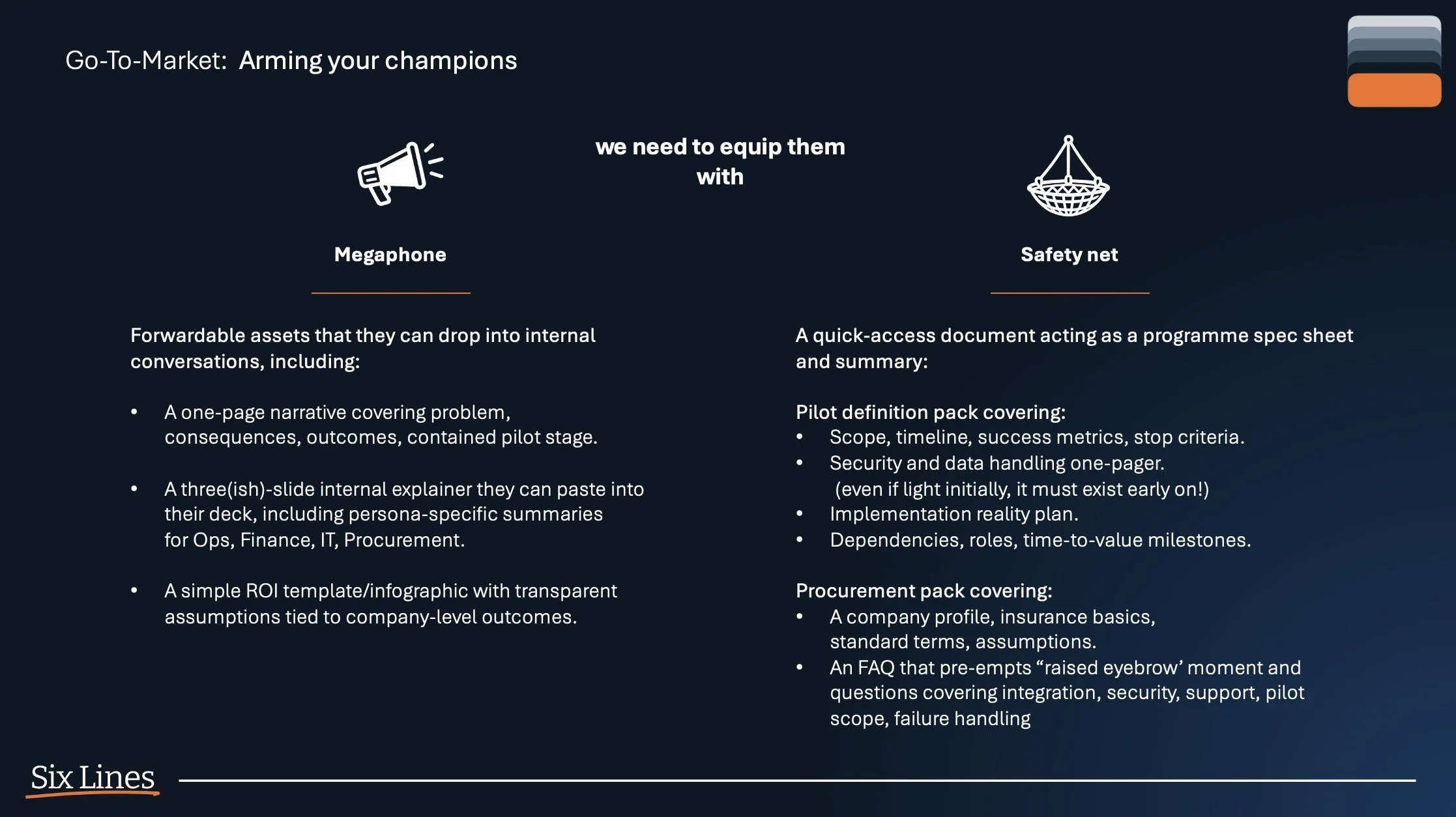
In automotive, adoption accelerates because someone inside the organisation chooses to champion it.
They are the one asking detailed questions about integration and responsibility. They are thinking about what will happen if this works, and what will happen if it does not. If you want sustained momentum, you need to equip that person.
You will often hear that the key to good marketing messaging is consistency. In automotive go-to-market, that advice can be misleading. A single, uniform message rarely survives a multi-stakeholder decision process. Each stakeholder is listening for something slightly different. Engineering is evaluating feasibility. Operations is evaluating efficiency. Procurement is evaluating risk and supplier stability. Compliance is evaluating exposure.
If you deliver the same message to all of them, you are likely telling most of them the wrong thing.
Persuasion in automotive rarely happens in the room. It happens afterwards, in internal conversations where your message must stand on its own. Companies that prepare for the moments they won’t be present for tend to progress. Those that don’t… don’t.
Provide concise summaries they can easily forward to colleagues. Clarify risks as well as benefits so they are not surprised by them later. Frame pilots in terms of business protection and measurable improvement rather than experimentation. If you’re able to connect your product directly to metrics they already report on, they’ll become your megaphone and your safety net when you’re not in the room. The more safety nets you have in that room, the better.
Six Lines Marketing
Granular best practices that reduce friction

We often see early automotive propositions falter on detail, when the presentation leaves room for doubt. Be specific about where your product fits in the programme lifecycle. Pre-SOP? Validation? Post-production monitoring? Compliance reporting? If buyers cannot picture the moment in which your solution is used, they’ll struggle to picture approving it.
Explain integration reality clearly. What systems does it sit alongside? What does it not replace? What dependencies exist? Automotive buyers are reassured when you demonstrate respect for existing infrastructure rather than implying reinvention. You might even be talking to the people that advocated building that infrastructure.
Define what a contained first step looks like. A narrowly scoped pilot with clear metrics, defined timelines and agreed success criteria makes internal approval easier. Open-ended transformation initiatives rarely survive initial scrutiny.
Finally, articulate outcomes in operational language. Cost-to-serve. Cycle time. Audit traceability. Late phase rework. These are the metrics that sit behind internal targets and reviews. Connecting your product to them reduces interpretive burden.
Questions we’re often asked about selling to OEMs
-
An automotive go-to-market strategy describes how a company introduces a product or service to the automotive industry in a way that aligns with how OEMs and suppliers actually evaluate risk, integration effort and supplier credibility.
Unlike many other enterprise sectors, automotive purchasing decisions involve multiple stakeholders across engineering, programme management, procurement, compliance and operations. A successful go-to-market approach therefore needs to explain how the product fits into existing programmes, reduces operational risk and supports measurable outcomes.
Companies entering the sector often find that their existing sales narrative works well in early meetings but struggles to survive the internal evaluation process that follows.
-
This usually happens because the internal justification for the purchase becomes difficult, with an increase of friction in the decision process.
An innovation or engineering team may see the value of a product during a meeting, but the proposal then moves through internal conversations involving procurement, compliance, programme leadership and finance. Each group evaluates the proposal through a different lens.
If messaging focuses mainly on features or architecture, those stakeholders must interpret the value themselves. When the impact on programme risk, operational metrics or compliance exposure is not clearly articulated, momentum tends to slow.
The meeting may have gone well, but the internal narrative needed to support the decision has not been fully built.
-
Vehicle programmes are long, expensive and tightly regulated. Decisions about new suppliers can affect integration complexity, safety compliance, warranty exposure and supplier relationships across multiple product cycles.
For that reason, new technologies are often evaluated as much on how safely they fit into existing programmes as on what they can do.
Companies entering the industry sometimes approach automotive with messaging developed for faster-moving sectors. That messaging can feel incomplete to automotive teams who are responsible for programme stability and long-term operational risk.
-
Automotive buying decisions rarely sit with one department.
Engineering teams evaluate technical feasibility and integration effort. Programme managers consider timing risk. Procurement reviews supplier stability and commercial exposure. Compliance teams assess regulatory implications. Operations teams look at efficiency and reliability.
A go-to-market strategy that assumes a single decision-maker often struggles once the conversation moves beyond the initial meeting.
-
Credibility usually comes from demonstrating an understanding of the environment the buyer operates in.
This can include acknowledging integration complexity, explaining how the product fits alongside existing systems, and being clear about validation and operational responsibilities. Buyers tend to respond well when suppliers show that they understand the constraints of vehicle programmes rather than presenting the product as a disruption to them.
Content that explores real industry challenges can also help build confidence before formal sales conversations begin.
-
Companies often consider external support when they notice a pattern of strong early meetings that do not progress into pilots or contracts.
At that point the issue is rarely product capability. More often it involves how the value is positioned, how the internal buying process is anticipated and how the messaging supports multiple stakeholders within the target organisation.
External support can help translate technical capability into a narrative that travels successfully through those internal conversations.
-
Messaging tends to resonate more strongly when it connects the product to the specific outcomes that automotive teams are already measured against.
These often include programme timing, cost-to-serve, production efficiency, audit traceability, compliance exposure and late-phase rework. When those outcomes are clearly explained, internal stakeholders can more easily justify the decision to colleagues and leadership.
Technical capability still matters, but the commercial narrative needs to explain why the capability improves programme outcomes.
-
Yes, although the details can look slightly different depending on the type of product.
The underlying challenge is the same. Automotive buyers still evaluate new suppliers through the lens of programme risk, integration responsibility, supplier reliability and long-term operational impact. Whether the product is software, hardware or a specialist engineering service, the internal decision process tends to involve multiple stakeholders who each carry a different form of risk.
Where the messaging differs is in the type of evidence buyers expect. Software companies are often asked about integration architecture, cybersecurity, data handling and validation processes. Hardware suppliers may need to demonstrate manufacturing repeatability, validation testing, durability data and supply chain resilience.
We have seen similar dynamics with some of our motorsport supplier clients. When those companies begin working with automotive manufacturers, the engineering capability is often obvious. What matters is how clearly the product’s role within a vehicle programme is explained, how the risks are understood and how the supplier demonstrates that they can deliver consistently at automotive scale.
The principle remains consistent. New suppliers succeed when their messaging helps buyers explain not just what the product does, but why adopting it makes the programme safer, more efficient or easier to defend internally.
Where Six Lines supports companies entering automotive
If your product performs well in other sectors but struggles to gain traction in automotive, the issue may not be capability. It may be interpretation, and interpretation can be shaped.
Six Lines supports companies entering the automotive sector who recognise that strong technology alone does not guarantee adoption.
Our work typically starts with a focused positioning and messaging session, to map your capability into automotive programme reality. Who signs off. Who carries risk. Where integration friction sits. What objections are likely to surface.
From there, we build the assets that help your product survive internal scrutiny. Clear narrative decks that speak to multiple stakeholders, not just end users. Concise internal summaries that your champions can forward. Defined pilot structures with measurable outcomes and contained scope.
For some businesses, that extends into ongoing go-to-market support. Refining messaging as it meets real buyers. Aligning website and sales materials with how automotive teams actually make decisions. Helping your internal advocates feel confident explaining your value in rooms you are not in. Building a custom marketing and sales playbook to get you into automotive.
We don’t do ‘louder’ marketing. We build marketing strategies designed to get deals made.
If you are entering automotive and finding that interest isn’t converting into progress, we should probably talk.
This article is part of Perspectives, our series of practical views on automotive marketing problems.