Automotive supplier marketing: How to explain software-defined value in a hardware-led industry
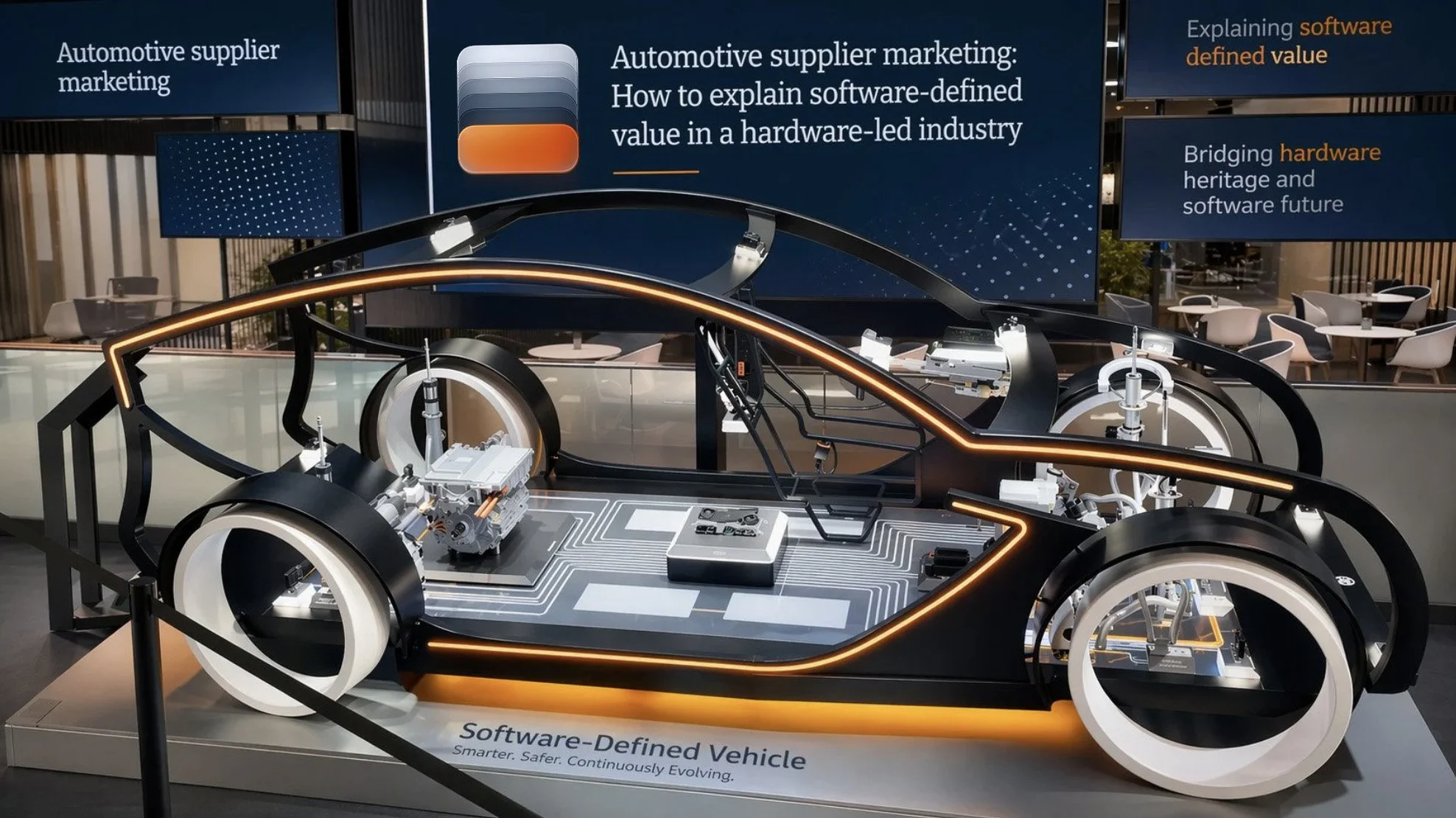
A lot of automotive suppliers are now creating value in ways that do not sit neatly inside the old language of component marketing. The vehicle is becoming more software-defined, the value of a system often continues long after SOP, and buyers are increasingly weighing questions around integration, updateability, cybersecurity, data, and long term flexibility alongside the underlying product itself. But many supplier websites and sales teams still present that value in a much older way, through feature lists, product descriptions, and technical claims that make sense in isolation, but doing too little to explain why the offer matters commercially inside the modern automotive buying process.
That creates a familiar kind of problem. The supplier may have something genuinely useful, commercially relevant, and technically difficult to replicate, but the way it is explained still asks too much of the buyer. Too much has to be inferred. Too much depends on the reader making the leap from what the system does to why that matters inside a programme, an architecture discussion, a risk review, or a budgeting conversation. In a market where good opportunities often move through several internal rooms before anything serious happens, that is a bad habit to keep in place.
It also creates a wider commercial issue, because a lot of specialist suppliers have moved into more software-led value creation without fully updating how they present themselves to the market. They may still sound like businesses selling a fixed product into a fixed cycle, when in reality the value sits in cleaner integration, more flexible updates, better control over vehicle behaviour, lower lifecycle friction, and a stronger ability to keep improving performance after launch. If that story is not being told clearly, the business can end up sounding much narrower, much more interchangeable, and much less commercially useful than it really is.
The industry has moved faster than many supplier websites
One of the underlying problems here is that the automotive market has changed faster than a lot of supplier messaging. For years, supplier marketing could get away with describing the product, the feature set, the technical capability, and the baseline proof of competence, because in many cases that was enough to support the first step in the conversation. It was not perfect, but it broadly matched the shape of the decision. The buyer was often trying to judge whether the supplier could deliver a defined thing into a known vehicle programme, against a known set of requirements, within a fairly established supply structure.
That is no longer the full picture for a lot of software-led offers. The value now often reaches further into the vehicle lifecycle, touches more parts of the organisation, and creates more of its benefit over time rather than only at the point of supply. A supplier may be contributing to how features evolve after launch, how updates are handled, how vehicle data is managed, how diagnostics improve, how service complexity changes, or how much architectural flexibility the OEM retains as the platform develops. Those things are commercially important, but they do not always show up clearly when the website still sounds like it is describing a conventional product line.
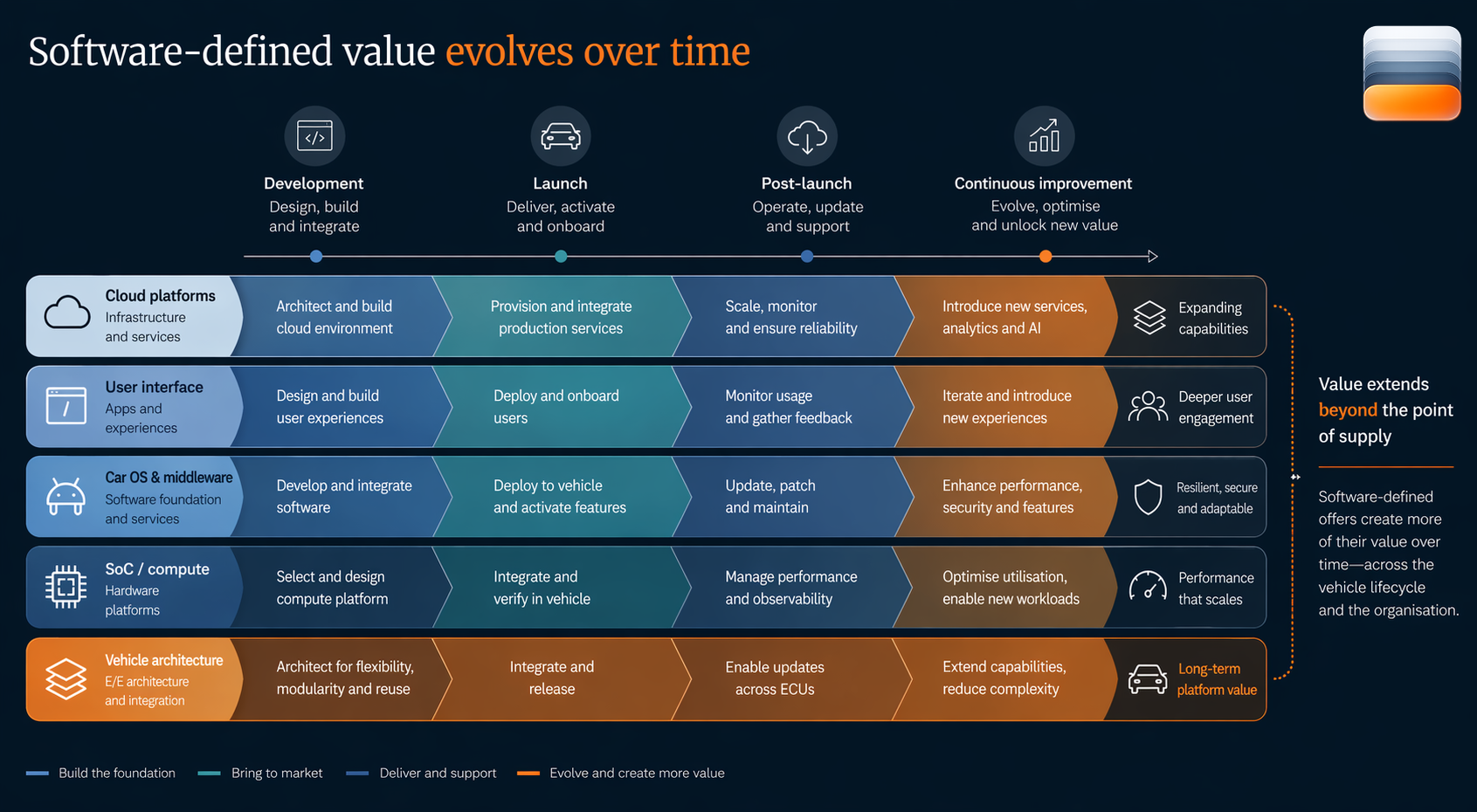
That is where the mismatch starts to hurt. The market has moved towards a more software-defined idea of value, but a lot of suppliers are still describing themselves in a language that feels rooted in hardware logic. That does not mean the old language is entirely wrong. It means it is incomplete, and when the most valuable part of the offer sits in what the solution changes over time, incomplete messaging can quietly flatten a business that should sound much more distinctive.
Software-defined value is harder to show if you only describe the function
Part of the reason this gets missed is that software-defined value is not always easy to show from the outside. A physical product gives the supplier something concrete to point at. It has shape, specification, placement, performance, and a fairly obvious role inside the vehicle. Software-led value often behaves differently. The function may still be clear enough in engineering terms, but the commercial meaning of that function sits one step further on, in the consequences it has for the programme, the platform, the update path, the servicing model, or the future usefulness of the vehicle architecture.
That matters because a lot of supplier messaging still stops at the first layer. It explains what the system does, what it integrates with, what feature it enables, what data it handles, or how it performs against a technical requirement. Useful, of course, but only up to a point. The harder and more commercially important question is what changes because that capability is in place. Does it make updates easier to manage. Does it reduce integration burden elsewhere. Does it improve control over feature deployment. Does it give the OEM more room to improve the vehicle after launch. Does it lower service complexity, reduce rework, strengthen cybersecurity discipline, or help future features get to market with less friction.
Those are the things that make a software-led proposition more persuasive. They are also the things that are easiest to leave under explained, especially when a business is still writing about itself as though technical correctness alone will do most of the work. In practice, technical correctness is only the starting point. The stronger commercial story usually sits in the effect the system has on the buyer’s world, and if that effect is not being made clear, the supplier is asking the market to do too much translation for itself.
The sale will not happen in one room
That translation gap matters even more because automotive buying decisions rarely move in a straight line. Good opportunities are not won simply because one person sees the technical value and agrees that it makes sense. They move through several internal rooms, each with its own priorities, each with its own concerns, and each with its own threshold for risk. A proposition that looks strong in the first discussion can still lose momentum later if the explanation does not survive contact with the wider buying process.
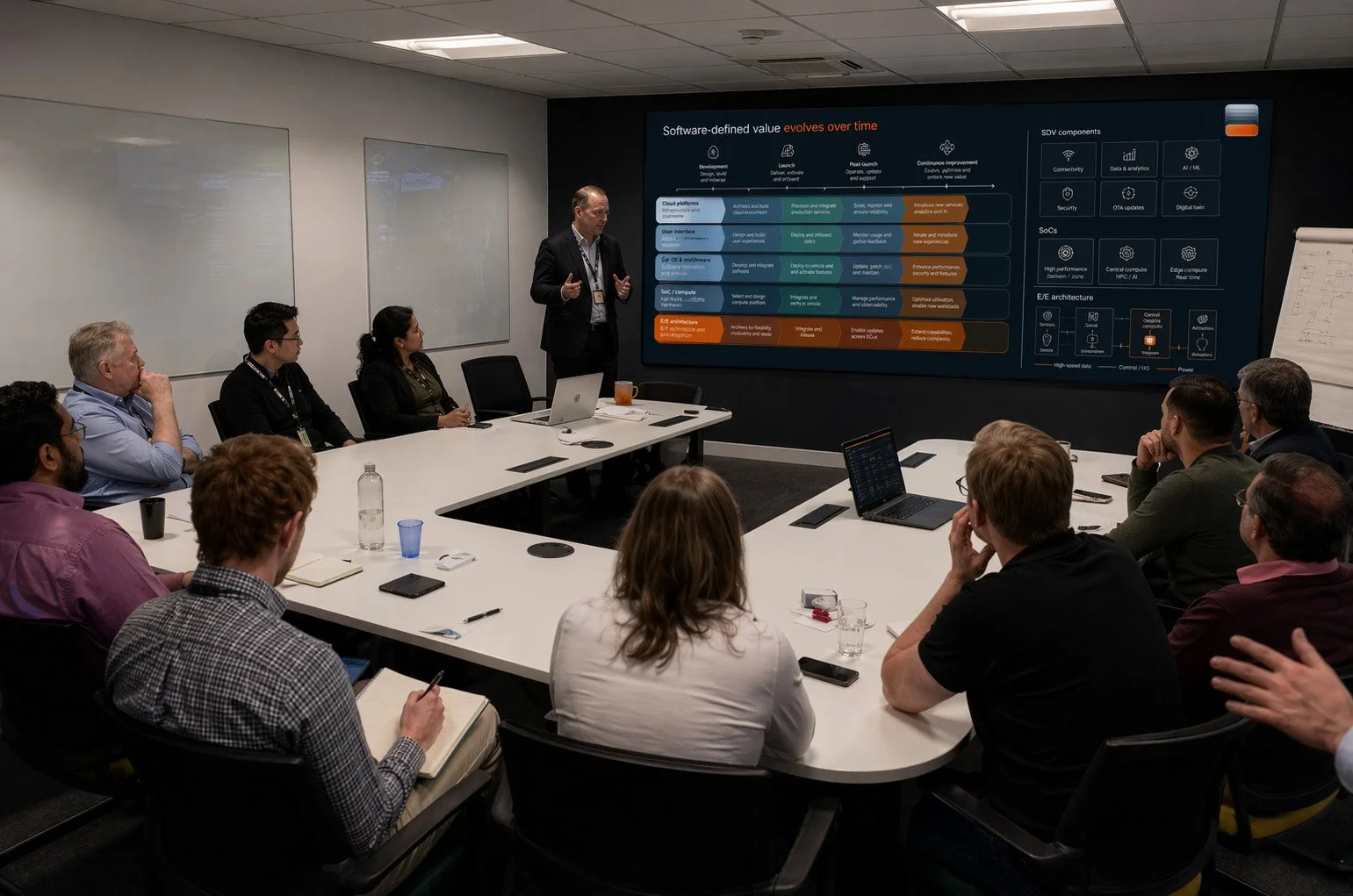
Engineering may respond first to the architecture, the system behaviour, the feasibility, or the cleanliness of the technical fit. Programme teams may be listening for timing risk, delivery complexity, validation burden, and the chance of late surprises. Procurement may be looking at supplier exposure, commercial leverage, and the practical shape of the relationship. Cybersecurity and compliance teams may be focused on resilience, governance, and the risks that come with data and update paths over time. Leadership may be trying to understand whether the supplier gives the business more control, more flexibility, and a more defendable long term position.
That matters because the proposition has to keep making sense as it travels. It is not enough for the offer to be technically sound in the first room if it becomes blurry, overcomplicated, or difficult to defend in the next three. This is one of the reasons strong automotive go to market work depends so heavily on buyer understanding. A good supplier does not simply need a message that sounds impressive in isolation. It needs one that can move through the organisation without losing shape, because the opportunity often slows not when the offer is rejected, but when confidence starts to drain out of the conversation from one room to the next.
Good marketing should match the outcomes each stakeholder is trying to protect
This is where automotive supplier marketing has to become much more deliberate. If the offer is moving through several internal rooms, the message needs to reflect the outcomes people in those rooms are actually trying to protect. That means the supplier has to do more than describe the capability accurately. It has to make clear what the capability changes for each group that will influence the decision.
For engineering, the most important outcome may be cleaner integration, lower complexity, more predictable behaviour, or less validation pain. For programme teams, it may be timing confidence, less risk of disruption, or a simpler route through the next phase of work. For procurement, it may be a more stable commercial model, lower exposure to downstream friction, or clearer confidence that the supplier will be sensible to work with when the detail starts to matter. For cybersecurity or compliance, the issue may be governance, risk management, and the practical implications of how the system behaves over time. For leadership, the outcome is often broader and more commercial. They may be asking whether this gives the business more control over future features, more flexibility over the vehicle lifecycle, or a stronger position than a more fixed and less adaptable alternative.
A lot of supplier marketing does not get that far. It describes the function with reasonable technical discipline, but leaves the buyer to translate the relevance of that function into the outcomes people inside the organisation will actually care about. That is where good opportunities often become heavier than they need to be. Someone inside the OEM or Tier 1 can see the value, but now they have to do the work of recasting it for other people, each of whom is trying to protect something slightly different. Stronger marketing reduces that burden. It helps the buyer carry the proposition through the organisation in a form that makes sense to each room it passes through.
A lot of suppliers still explain what the system does, but not what it changes
This is probably the clearest messaging problem in the whole area. Many suppliers explain the system itself in detail, but do much less to explain what changes if the customer adopts it. There may be a strong description of the architecture, the toolset, the workflow, the module, the integration path, or the feature set, but much less clarity around the effect this has on programme risk, engineering workload, lifecycle flexibility, update control, service burden, or future commercial value.
That is a problem because change is usually what the buyer is trying to justify. Inside an OEM or Tier 1, people are often not defending a piece of technology in abstract terms. They are defending the idea that this approach leads to a better outcome than the alternatives. It may make the programme safer. It may reduce internal workload. It may create a cleaner update path. It may improve how quickly new functions can be deployed. It may reduce the cost or difficulty of managing the platform later. It may simply create a more controlled and sensible technical foundation than the business would otherwise have. But if the supplier never quite says what is changed and improved, the most commercially useful part of the story is left half buried.
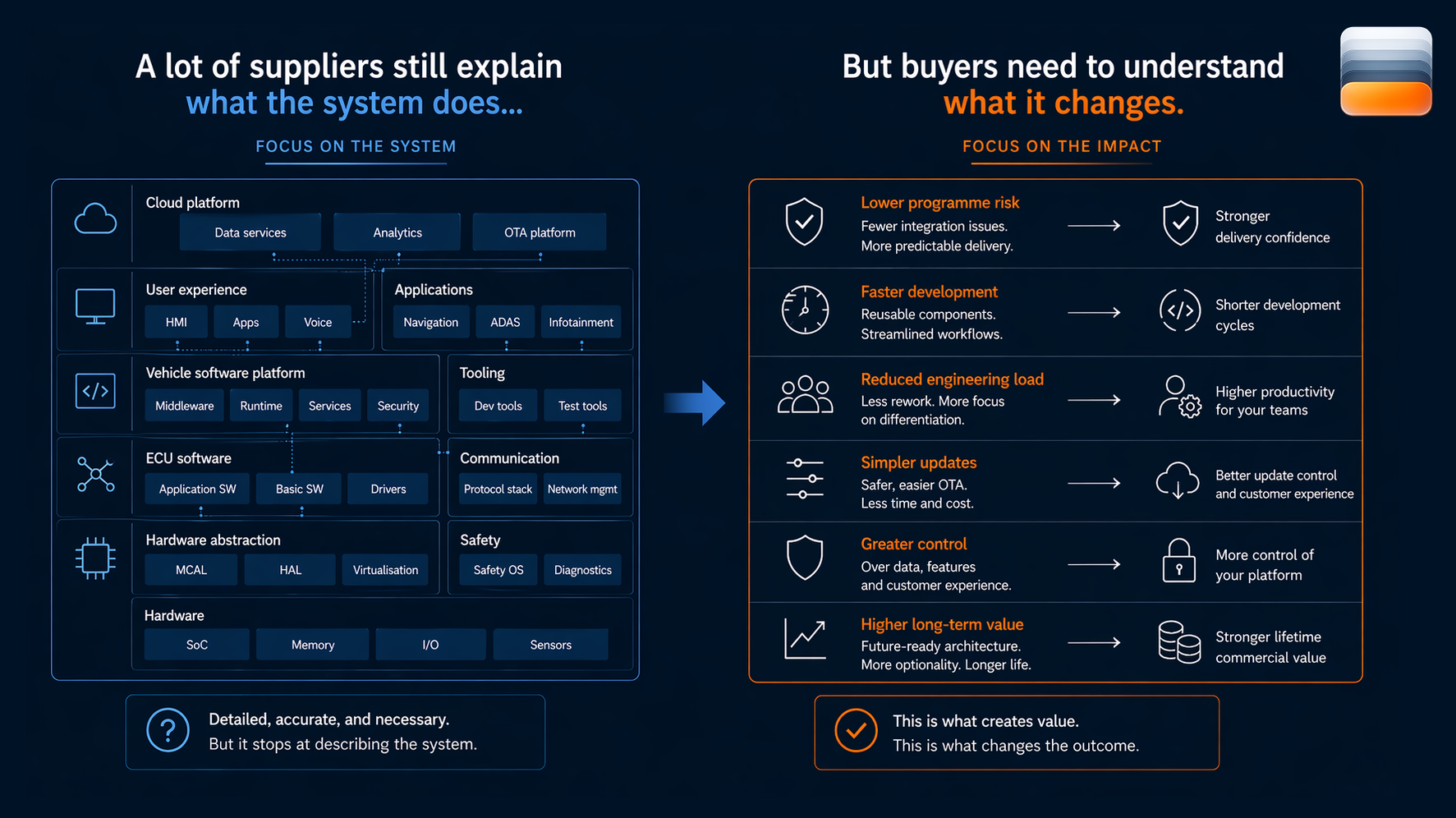
This is where a lot of very capable businesses still under explain themselves. They may have the engineering substance. They may understand the vehicle context. They may know exactly why their offer matters. But if the public explanation still leans too heavily on describing the thing rather than describing the difference it makes, the message remains thinner than it should be. That leaves too much room for hesitation, and in automotive sales that hesitation rarely announces itself dramatically. More often it simply slows a conversation that should have had more momentum behind it.
Your internal champion still has to sell it when you are not there
One of the most useful tests for any supplier messaging is whether it helps someone inside the customer organisation repeat the story with confidence once the supplier has left the room. That is where a lot of opportunities are won or lost. The meeting itself matters, of course, but the real movement often happens afterwards, when someone has to carry the proposition into another conversation and explain why it deserves to keep moving.
That internal champion needs more than a technical summary. They need something that works as both a megaphone and a safety net. The megaphone is what helps them carry the message further inside the business. It is the clear narrative that explains the problem, the consequences of leaving it alone, the outcomes that improve if your offer is adopted, and why the first step is sensible and contained. That might take the form of a one page summary, a short internal explainer they can lift into a deck, or a simple ROI model tied to outcomes their colleagues already care about. Whatever form it takes, it needs to help them explain the value in language that still works once the supplier is no longer there to do the explaining in person.
But they also need a safety net. That is the material that helps them hold the ground they have made when the conversation shifts from interest to scrutiny. Questions around integration, security, support, data handling, implementation reality, dependencies, pilot scope, and failure handling do not usually arrive at the very end as some tidy procurement exercise. They often appear just as the opportunity is starting to gather momentum, and if those answers are vague, missing, or too hard to find, confidence can drain out of the discussion surprisingly quickly.
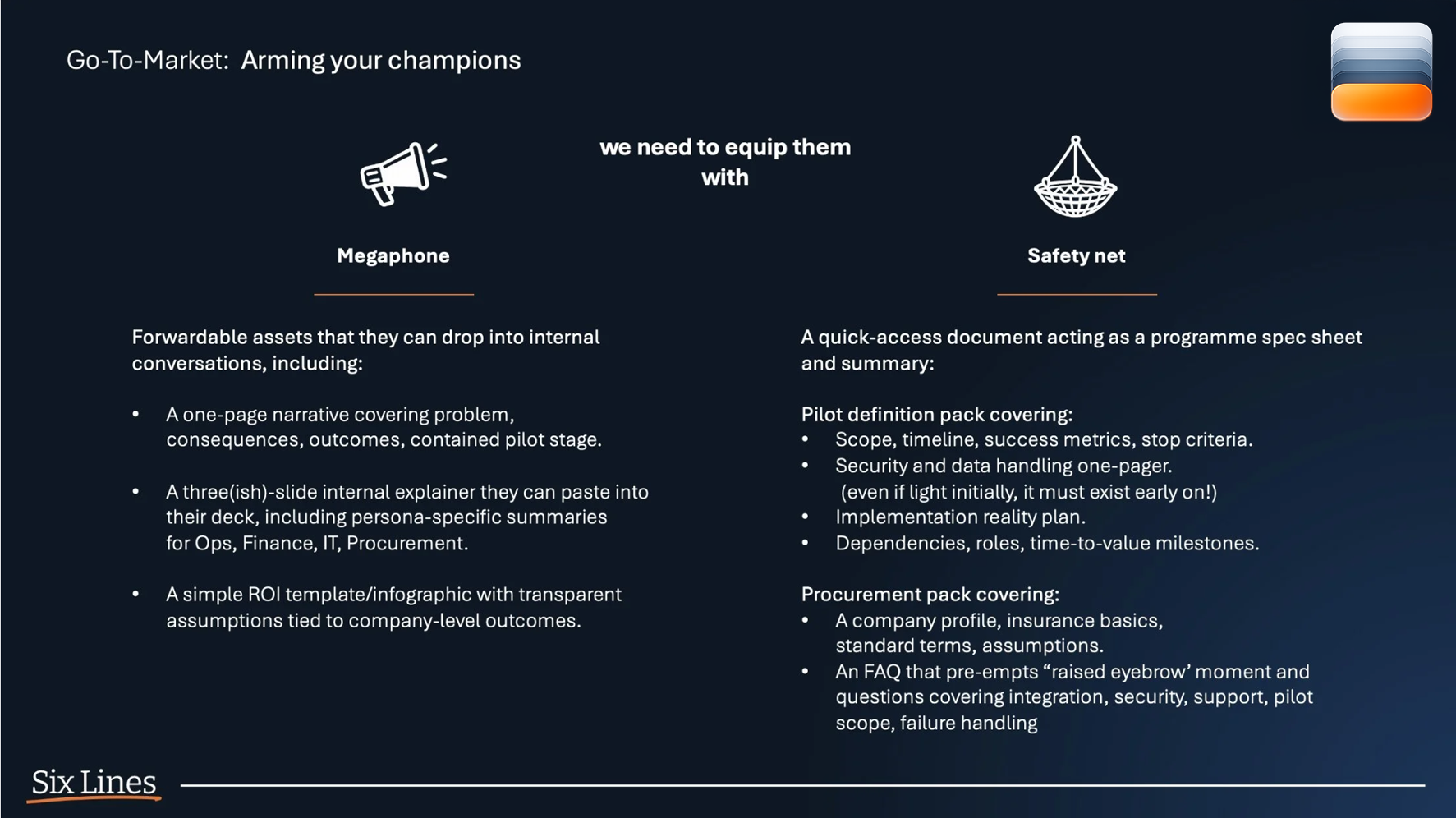
That is why the website, the deck, the case study, the white paper, and the follow up material all matter more than some suppliers assume. These are often the tools the internal buyer uses to keep the opportunity alive once the first conversation has ended. A good supplier does not leave that person with a feature list and a broad promise that it will all make sense later. It equips them with material that helps them advocate for the idea, answer the raised eyebrow moments, and keep the case moving through the business with less friction. When that is done properly, marketing starts to do real commercial work long after the meeting is over.
Where Six Lines fits
Six Lines works with automotive suppliers that already have something real to say, but know that the way they currently present that value is doing less commercial work than it should.
In practice, support usually starts in one of three places:
A focused review of how the business is currently presenting itself
This means looking at the website, decks, and core messaging through the lens of how automotive decisions are actually made, rather than judging the material on surface polish alone. The aim is to identify where the value is becoming too technical, too fixed, too product-led, or too vague to move cleanly through the buying process.
Clearer positioning around buyer outcomes
This usually means helping the supplier explain what actually improves when its solution is in place, and making that value easier to understand in the rooms where engineering, programme, procurement, compliance, and leadership are each listening for something slightly different. The point is not to make the business sound more fashionable. It is to make the real commercial effect of the offer easier to see and easier to defend.
Ongoing content and sales support
This can include website structure, sector pages, case studies, white papers, follow up material, and wider messaging support that helps the proposition hold its shape after the first meeting. Not noise for the sake of it, but the kind of material that helps internal champions carry the value forward when the supplier is no longer there to explain it in person.
We are not looking for louder marketing here. It is clearer communication that helps automotive suppliers explain software-defined value more convincingly, support stronger buyer confidence, and create better commercial momentum from the capability they already have.
And if your offer is strong, but too much of its value still depends on the buyer joining the dots for themselves once the meeting is over, we should probably talk…